
Chronology
Trial, Sentencing, Abjuration
1631-1633
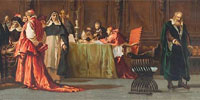

The
election of Pope Urban VIII in 1623 roused new hopes in Galileo, who mistakenly
believed that he could resume his battle in defence of the new astronomy. This
hope led him to publish, in 1632, the Dialogo
sopra i due massimi sistemi del mondo [Dialogue
on the Two Great World Systems] (Florence, 1632), an explicitly Copernican work.
The
Dialogo was sequestered and Galileo,
in January 1633, was summoned to Rome by the Court of the Inquisition. The
trial ended on June 22nd of the same year, with the sentence of life
imprisonment proclaimed against Galileo, who was forced to abjure. Consigned to
the residence of the Tuscan ambassador to Rome, he was then allowed to leave
the Papal city and was offered hospitality in Siena by his friend Archbishop
Ascanio Piccolomini. Finally, on December 1, 1633, the Congregation of the Holy
Office allowed him to retire to his home at Arcetri, forbidding him however to
receive any persons with whom he might discuss his scientific theories.